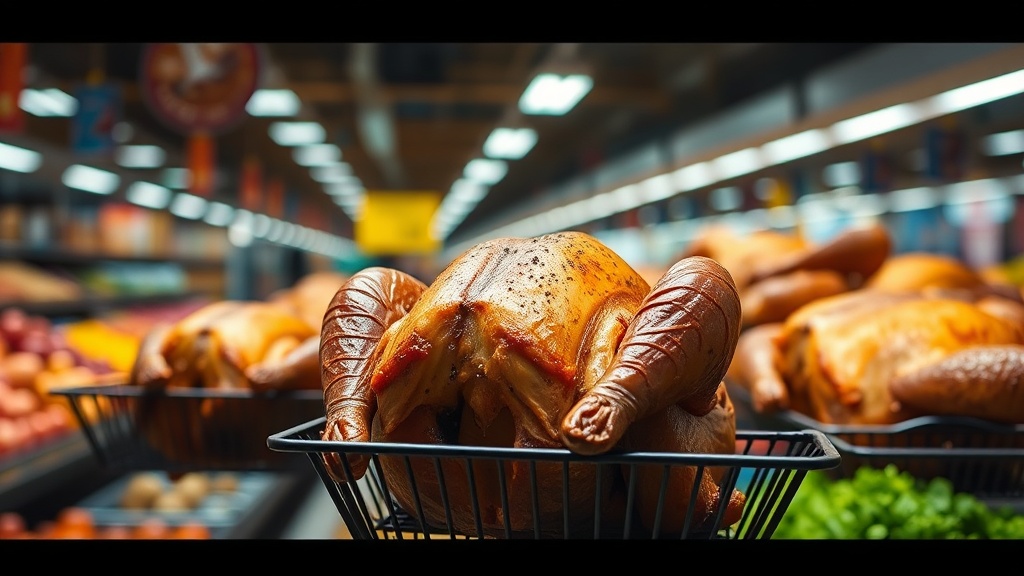
Stop Wasting Money on Grocery Store Rotisserie Chickens

The plastic dome of a grocery store rotisserie chicken is often a visual trap. It sits under the heat lamp, glistening with oil and salt, positioned right at eye level to trigger an impulse purchase. While these chickens are marketed as a convenient, low-cost meal solution, they are frequently a high-margin item for the retailer and a low-ROI choice for your household budget. This guide breaks down the actual cost-per-ounce of rotisserie chickens versus strategic alternatives, teaching you how to reclaim that lost margin through smarter procurement and meal planning.
The Hidden Math of the Rotisserie Chicken
To understand why the rotisserie chicken is a poor financial decision, we have to look at the unit price. Most major retailers, such as Walmart, Kroger, or Publix, price their hot rotisserie chickens at a psychological "sweet spot"—usually between $4.99 and $7.99. On the surface, this looks like a massive discount compared to buying raw chicken breasts. However, you are paying a premium for convenience and moisture retention that is often achieved through heavy sodium loading.
When you buy a rotisserie chicken, you are not just paying for the meat; you are paying for the labor of the store, the energy used by the rotisserie ovens, and the shrink factor. A standard rotisserie chicken might weigh 3 pounds, but after you strip the meat from the bones, the actual edible yield is significantly lower. If you are paying $6.99 for a chicken that yields only 1.5 pounds of usable meat, your price per pound for actual protein has skyrocketed compared to buying raw poultry.
Furthermore, the high sodium content in pre-cooked chickens can lead to "hidden costs" in your health and food utility. High salt levels cause the meat to hold water, which can actually decrease the actual protein density per ounce. If your goal is to maximize protein intake for the lowest possible cost, the rotisserie chicken is an inefficient vehicle for that goal.
The "Yield vs. Cost" Calculation
Before you grab that plastic container, perform a quick mental audit of the yield. To shop like a forensic accountant, you must focus on the cost per usable ounce rather than the price per unit. Here is how the math typically breaks down when comparing a rotisserie chicken to raw chicken thighs or breasts.
- Rotisserie Chicken: $6.99 for roughly 24 ounces of usable meat = $0.29 per ounce.
- Raw Chicken Thighs (Bulk): $1.89/lb (approx. 16 oz) = $0.11 per ounce.
- Raw Chicken Breasts (Bulk): $3.49/lb (approx. 16 oz) = $0.21 per ounce.
In this scenario, the "convenient" chicken is nearly 30% more expensive per ounce than the raw chicken breasts. When you factor in the time it takes to cook the raw chicken—which can be done in an air fryer or a slow cooker while you perform other tasks—the "convenience" premium is a bad trade-off for your household's capital.
High-ROI Alternatives to the Hot Deli Section
If you need a quick protein source but want to maintain a strict grocery budget, switch your procurement strategy to these three methods. These options provide better nutritional density and a much lower price-per-ounce.
1. The Bulk Raw Poultry Method
Instead of looking for cooked meat, look for family packs of raw chicken thighs or drumsticks. These are often the most undervalued items in the meat department. A family pack of drumsticks at a store like Aldi or Costco can often be found at a significantly lower price point than even the cheapest rotisserie chicken. You can season them with basic pantry staples like garlic powder, paprika, and salt, then roast them in a single batch to use throughout the week.
2. The Frozen Poultry Strategy
Frozen chicken breasts or thighs are the ultimate hedge against food waste and price fluctuations. Unlike the rotisserie chicken, which has a very short shelf life once opened, frozen poultry can be kept in your freezer until the exact moment of need. This allows you to buy when prices are at their lowest. To avoid the "thawing bottleneck," learn to use a rapid defrost method or cook directly from frozen in an Instant Pot.
3. The "Sunday Prep" System
If you find yourself buying rotisserie chickens because you are too tired to cook on a weekday, you are suffering from a lack of a system, not a lack of time. Instead of buying a pre-cooked chicken, dedicate two hours on a Sunday to roasting two large whole chickens or a large batch of thighs. This "batch processing" allows you to distribute the labor over an entire week of meals, effectively lowering your "labor cost" per meal to nearly zero.
When the Rotisserie Chicken is Actually a Deal
As a rule, I advocate against the rotisserie chicken, but there is one specific exception: The Clearance Window. Because these chickens have a limited shelf life, many grocery stores implement a steep discount toward the end of the day or the end of the week. If you see a "Manager's Special" or a "Reduced for Quick Sale" sticker on a rotisserie chicken, the math changes.
"A deal is only a deal if the price-per-ounce is lower than the raw alternative. If that $6.99 chicken is marked down to $2.99, you have just successfully bypassed the labor cost and secured a high-margin win."
If you find a chicken at a 50% discount, it becomes a viable tool for meal prepping. You can shred the meat immediately and use it for tacos, salads, or pasta throughout the week. However, if you are paying full retail price, you are simply donating your grocery budget to the store's profit margin.
Optimizing Your Meat Procurement
To truly master your grocery budget, you must stop looking at meals and start looking at ingredients. When you shop for a "rotisserie chicken," you are shopping for a single meal. When you shop for "bulk chicken thighs," you are shopping for a foundation of multiple meals.
To further refine your strategy, ensure you are also looking at the shelf-stable and clearance sections of your store. Knowing the best times to shop for grocery clearance items can help you identify when the meat department is liquidating high-value proteins at a fraction of the cost. Combining a clearance meat find with a strategic meal plan is how you move from a consumer to a household CFO.
For those still struggling to navigate the transition from name-brand convenience to budget-friendly efficiency, I highly recommend reviewing my complete couponing guide for beginners. It provides the structural framework necessary to move away from impulse-driven shopping and toward data-driven procurement.
The Final Audit: Your New Shopping Checklist
Before you head to the deli counter during your next grocery run, run through this quick mental checklist to ensure you aren't falling for the "Rotisserie Trap":
- Check the Unit Price: Is the price per ounce actually lower than the raw meat in the butcher case?
- Assess the Yield: Am I paying for water weight and skin, or actual protein?
- Evaluate the Time-to-Value Ratio: Can I roast a batch of raw thighs in an air fryer in 20 minutes while I do something else?
- Look for the Sticker: Is there a "Reduced for Quick Sale" mark that makes this a legitimate clearance win?
By applying these forensic accounting principles to your weekly grocery run, you stop being a victim of clever marketing and start being the manager of your household's most important variable expense: food. Stop paying the convenience tax and start investing in high-yield ingredients.