Tax Refund Grocery Strategy: Turn $2K Into a Year of Freezer Gold

Okay, real talk: every March I watch people get their tax refunds and immediately spend them on... the same groceries they were already going to buy. Maybe they splurge on a nicer cut of beef. Maybe they stock up on chips. And then two months later, nothing has changed about their grocery bill.
This year I want to change that for you.
I've been thinking about this a lot because our refund landed last week — $1,847, which felt like a lot and also like nothing simultaneously, because welcome to being an adult. My husband wanted to put the whole thing toward a new couch. I wanted to put a chunk of it toward the freezer. We compromised. (The freezer won more than the couch did, but that's between me and the budget spreadsheet.)
Here's what I actually know after three years of doing this intentionally: a well-deployed $1,500–$2,000 refund into strategic freezer buys can save you $150–$250 a month on groceries for the rest of the year. That's a real return. That's not me doing hopeful math — that's me tracking actual receipts.
Let me show you how.
The Framework: Not Every Category Is Worth It
Before we talk dollars, we need to talk categories. Because bulk buying is not universally good, and the refund-grocery fantasy breaks down fast when you buy the wrong things.
Buy in bulk with a refund:
- Proteins (ground beef, chicken thighs, pork shoulder, whole chickens)
- Butter — it freezes perfectly and prices have been volatile lately
- Hard cheeses (cheddar blocks, parmesan — freeze surprisingly well)
- Baking staples (flour, sugar, baking powder — if you actually bake)
- Frozen vegetables (store brand, name brand, doesn't matter — if you eat them)
- Dry beans, lentils, pasta, canned tomatoes (if you have storage space)
Do NOT bulk buy with a refund:
- Fresh produce (obviously — you're not a grocery store)
- Anything with a shelf life under two weeks
- Anything you've never actually cooked before
- Items that are "on sale" but not actually discounted from the real market price
That last one is sneaky. Costco's regular price on a lot of items is only marginally better than a sale price at Kroger. The bulk buy math only works when you're comparing warehouse price vs. full-price grocery store — not warehouse vs. a good Kroger sale. More on timing in a bit.
The Math by Refund Tier
Let me give you a framework based on what I've actually seen work. I'm deliberately not listing specific per-pound prices here because they shift week to week and market to market — before any big buy, check the current price per pound at your Costco or Sam's against what you'd actually pay full-price at your grocery store. The spread is what matters.
If you have $500 to deploy
This is enough to do one focused category really well. My pick: proteins.
The math I use: if bulk ground beef is $1–$1.50/lb cheaper than regular grocery store price, a family using 2 lbs a week captures $50–$65/month in savings on that item alone. That's the type of comparison to run before you load up the cart — not "is this a good price" in the abstract, but "how does this compare to what I'd actually pay Thursday night at Harris Teeter?"
With $500, you could stock:
- 30–40 lbs of ground beef (check current Costco bulk pack pricing)
- 20–30 lbs of boneless chicken thighs (Sam's Club and Costco both do large multi-packs)
- 8–10 lbs of butter (freeze it — butter prices have been anything but stable)
- Whatever's left toward proteins you actually cook regularly
That's a freezer stocked with 3–4 months of protein for one category.
If you have $1,000 to deploy
Now you can do proteins AND pantry staples.
Add to the protein buy:
- Large bag of all-purpose flour (check Sam's or Costco vs. grocery store equivalent weight)
- Canned tomatoes, case quantity (the per-can savings at warehouse clubs are real and consistent)
- 10 lbs frozen broccoli or mixed veg (the per-serving math here almost always wins vs. fresh)
- A large block of sharp cheddar (yes, you can freeze it — wrap individual portions in plastic before freezing)
At this tier, the Costco or Sam's Club annual membership absolutely pays for itself in a single trip. More on membership costs below.
If you have $2,000–$2,500 to deploy
This is where it gets genuinely interesting, and where you need to be honest with yourself about your freezer capacity.
At this tier, I'd split the spend: roughly half on proteins and frozen goods, half on non-perishable pantry staples. The pantry half has zero spoilage risk.
Realistic $2,000 split:
- Freezer (~$900): Proteins (ground beef, chicken thighs, pork shoulder), butter, hard cheese, frozen vegetables
- Pantry (~$600): Canned goods, pasta, flour, sugar, olive oil (Kirkland 2-pack is legitimately good), rice if you eat it
- Hold back (~$500): April seasonal produce buys when strawberries and asparagus hit their price floors
That holdback is important. March isn't when you buy produce — April is. I'll explain below.
Honest Freezer Capacity Check
I need to stop here because this is where the fantasy breaks down for a lot of people.
A standard fridge-freezer combo with the freezer on top is typically 4–5 cubic feet total. Side-by-side units often have 14–16 cubic feet for the freezer half, but feel smaller because of the vertical layout. Either way: one cubic foot of freezer space holds roughly 25–30 lbs of meat when densely packed, vacuum sealed or flat-frozen.
So realistically, a standard freezer cleared out and organized can hold maybe 60–80 lbs of frozen protein if you're serious about it. That's not nothing — at current market prices that's several hundred dollars of protein — but it's not "200 lbs of ground beef" territory.
Lily's actual system:
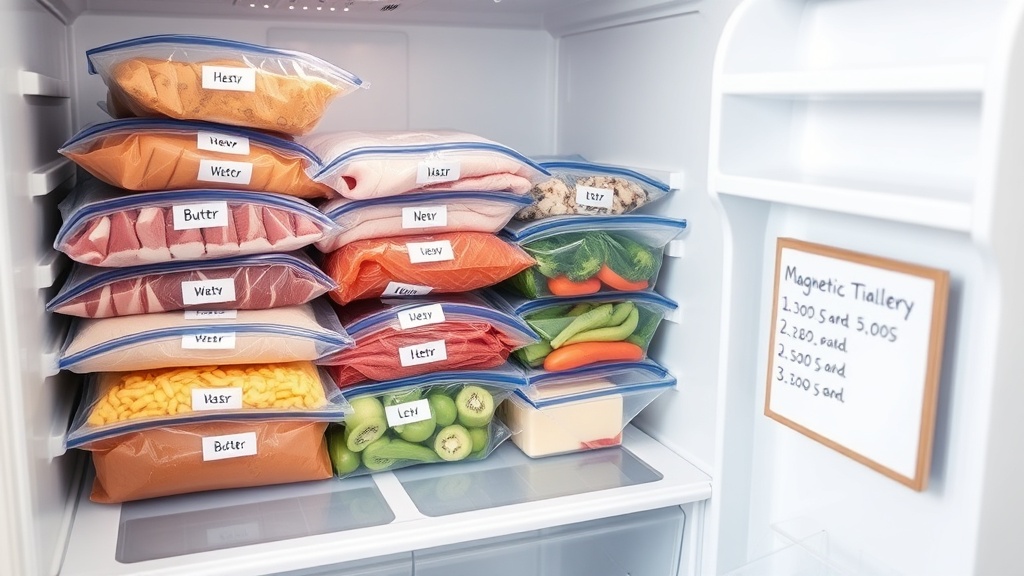
- Full freezer audit before any bulk buy. Everything comes out, gets labeled, gets used or tossed.
- Ground beef gets frozen flat in 1-lb portions (labeled zip bags). This is the only way to actually use it efficiently.
- Chicken thighs go in portion-size bags of 4. Pork shoulder gets cut into 1.5–2 lb chunks before freezing.
- I use a magnetic whiteboard on the side of my fridge. Every bag that goes in gets a mark. Every bag that comes out loses a mark. This sounds annoying. It takes 5 seconds. It's the only thing that's ever worked for me to avoid waste.
If you are not willing to do this level of organization, buy less. A freezer full of stuff you can't find or forgot you had is not a savings strategy — it's a waste strategy.
March/April Timing: What to Buy NOW vs. Wait
This is where being a deal nerd actually pays off — but I want to be clear that I'm talking about historical seasonal patterns, not a guarantee of what your store will have this week.
Generally good to buy now in March:
- Ground beef and pork shoulder: Late winter has historically been more favorable for these cuts before grilling season demand picks up in late April/May. Worth stocking up if your freezer has room.
- Chicken thighs: Relatively stable year-round, but dark meat prices tend to climb as grilling season approaches. Buy now if you have space.
- Butter: If you bake, this is not a wait-and-see item — dairy prices are volatile. Stock up.
Worth waiting until April:
- Whole chickens: Whole bird prices often soften slightly in spring as supply increases.
- Strawberries: Do not buy bulk frozen strawberries now. April/May California strawberry season means fresh prices fall hard and you can freeze your own.
- Asparagus: March asparagus is expensive imported product. Give it 4–6 weeks.
- Lamb: The week before Easter is historically one of the best times of year to buy whole legs and shoulders. Mark your calendar.
Skip for now:
- Fresh citrus season is winding down. Don't bulk buy lemons or limes expecting a deal — prices tend to rise through summer.
Note: these patterns are directionally reliable but actual prices depend on your market. Always verify the spread at your store before loading up.
The 12-Month Payoff Audit
Here's the honest math I promised you.
If you deploy $2,000 into a strategic freezer and pantry buy in March, here's a realistic savings projection — using conservative ranges based on typical wholesale-vs-retail spreads, not any specific current prices:
| Category | Spend | Monthly Savings (est.) | 6-Month Total |
|---|---|---|---|
| Proteins (beef/chicken/pork) | $900 | $70–$90 | $420–$540 |
| Butter + cheese | $150 | $15–$20 | $90–$120 |
| Pantry staples (flour, canned, pasta) | $400 | $30–$40 | $180–$240 |
| Frozen vegetables | $150 | $15–$20 | $90–$120 |
| Total | $1,600 | $130–$170/mo | $780–$1,020 |
By month 6 (September), you've gotten your $1,600 back. Everything from October through December is pure savings.
The catch: this only works if you actually use what you bought. I have had years where I bought too much and wasted it. The waste math is brutal — throwing out 10 lbs of freezer-burned beef is real money gone. Do not over-buy your actual cooking capacity.
My rule: buy 2 months of what you actually cook, not what you aspire to cook. If you haven't made pork shoulder in the last 3 months, buying 15 lbs of it on a refund high is a mistake.
Before You Go: The Membership Question
Is a Costco or Sam's Club membership worth it for a single bulk-buy trip?
Sam's Club: Basic Club membership is currently around $50/year — verify their current pricing before signing up, as they adjust it periodically. They often run new-member promotions that knock the real cost down. If a single trip saves you $60–$80 on proteins and pantry items (genuinely realistic), it pays for itself immediately.
Costco: Gold Star membership is $65/year. Same math applies. Costco tends to win on produce, olive oil, rotisserie chicken, and cheese. Sam's tends to win on meat pricing in many markets. Worth visiting both if you have access to both.
Neither: If you live near a Restaurant Depot or a cash-and-carry wholesale club, those sometimes beat warehouse club pricing on proteins without any annual fee. Worth checking your area.
My take: if you're doing even one serious bulk buy per year, the membership pays for itself easily. I renewed mine last month without hesitation.
Tax refund season is one of those rare moments where a lump sum can actually change your monthly budget for the better — but only if you're deliberate. Buy what you'll use, freeze what you can find, and track it so you actually know if it worked.
The math is real. The savings are real. You just have to not get excited and buy 14 pounds of something you've never cooked.
Happy hunting. And label your bags.