The Store Brand Audit: I Bought 34 Items Twice and the Math Says You're Overpaying by $1,650 a Year

I did something slightly unhinged last month. I bought two of everything on my grocery list — one name brand, one store brand — and ran a full unit-price comparison on 34 items across three stores. My husband Derek looked at the double cart and said "are we hosting something?" No, Derek. We're doing science.
Here's what I found: switching to store brand on just the items where it made mathematical sense saved me $31.74 on a single weekly shop. Annualized, that's $1,650 in savings without changing a single meal I cook for Ollie or clipping a single coupon.
But here's the thing — not every store brand swap is worth it. Some are identical products in different packaging. Some are genuinely worse. And a few store brands are actually better than the name brand. You need the math to tell the difference.
The 34-Item Audit: What I Actually Found
I tested across Aldi, Kroger, and Walmart because those are my three regular stores. I compared unit prices (price per ounce, per count, per fluid ounce — whatever the standard unit is for that category) on identical or equivalent products.
The average store brand discount across all 34 items: 28.4% cheaper per unit. But that average hides a huge range. Some categories crushed it. Others barely moved the needle.
The Slam Dunks (35%+ savings, no quality difference)
- Canned tomatoes: Kroger brand vs. Hunt's — $0.04/oz vs. $0.07/oz. That's a 43% savings and I genuinely cannot tell them apart in chili. Aldi's canned tomatoes are even cheaper at $0.03/oz.
- Rice (long grain white): Great Value vs. Mahatma — $0.03/oz vs. $0.05/oz. It's rice. It's the same rice. 40% savings.
- Frozen vegetables: Store brand mixed veggies average $0.08/oz across all three stores vs. Birds Eye at $0.13/oz. That's 38% savings for vegetables that were flash-frozen in the same three facilities in the Midwest.
- Butter: Aldi's Countryside Creamery at $0.22/oz vs. Land O'Lakes at $0.34/oz. Same USDA grade AA. 35% savings.
- Pasta: Any store brand vs. Barilla — roughly $0.06/oz vs. $0.10/oz. 40% savings. I cooked them side by side. Derek and Ollie ate both without comment.
- Baking staples (flour, sugar, baking soda): 35-45% cheaper across the board. These are commodity products. There is literally one company making most of the baking soda in North America regardless of whose name is on the box.
The Moderate Wins (15-34% savings, minor or no difference)
- Shredded cheese: 22% cheaper store brand, and fine for cooking. I wouldn't serve Kroger shredded cheddar on a cheese board, but melted on tacos? Identical.
- Yogurt (plain): 19% savings store brand. The texture is slightly thinner on some store brands but nutritionally equivalent.
- Cereal: This one's interesting — store brand "Toasted Oats" vs. Cheerios saves about 28%, but my kid won't eat the store brand version. So the savings are $0 if it goes in the trash. Know your audience.
- Cooking oil (vegetable/canola): 18% savings. Oil is oil is oil.
- Chicken broth: 25% cheaper store brand. Honestly the Kroger broth has slightly less sodium which I prefer anyway.
The Skip-Its (Not worth switching)
- Ketchup: Only 8% savings, and Great Value ketchup is noticeably more vinegary than Heinz. My household has Opinions about ketchup.
- Trash bags: Store brand bags rip. I tested this three times. The per-bag savings of $0.04 is meaningless when you're double-bagging because the first one split. Actual unit cost ends up higher.
- Coffee: Very personal. I tried Aldi's store brand medium roast and it was fine. But coffee is my one non-negotiable treat. If you're not particular, the savings are about 31% — real money. But I'm particular.
- Paper towels: Store brand paper towels require more sheets per task. When I calculated effective cost per "job done" instead of cost per sheet, the savings dropped to about 4%. Not worth it.
- Diapers: I know this isn't groceries exactly, but since Ollie's still in pull-ups and I buy them at the grocery store — store brand diapers have a 15% higher leak rate in my extremely scientific sample size of one toddler. Hard pass.
The Store Brand Tier List
Not all store brands are created equal. After two years of obsessive testing:
Aldi (Friendly Farms, Simply Nature, Clancy's): Best overall value. Their stuff is genuinely good and frequently 35-50% cheaper than name brand equivalents. Their cheese selection in particular punches way above its price point.
Kroger (Private Selection, Simple Truth): Private Selection is their premium line and it's legitimately excellent — sometimes better than the name brand it's competing with. Simple Truth Organic is competitive with national organic brands at 20-30% less. Regular Kroger brand is solid for staples.
Walmart (Great Value): Cheapest absolute prices but more inconsistent quality. Great for true commodity items (flour, sugar, canned goods, oil). I'd be more cautious with their dairy and prepared foods.
The Calculator Rule
Here's my actual methodology, because I know some of you want the process:
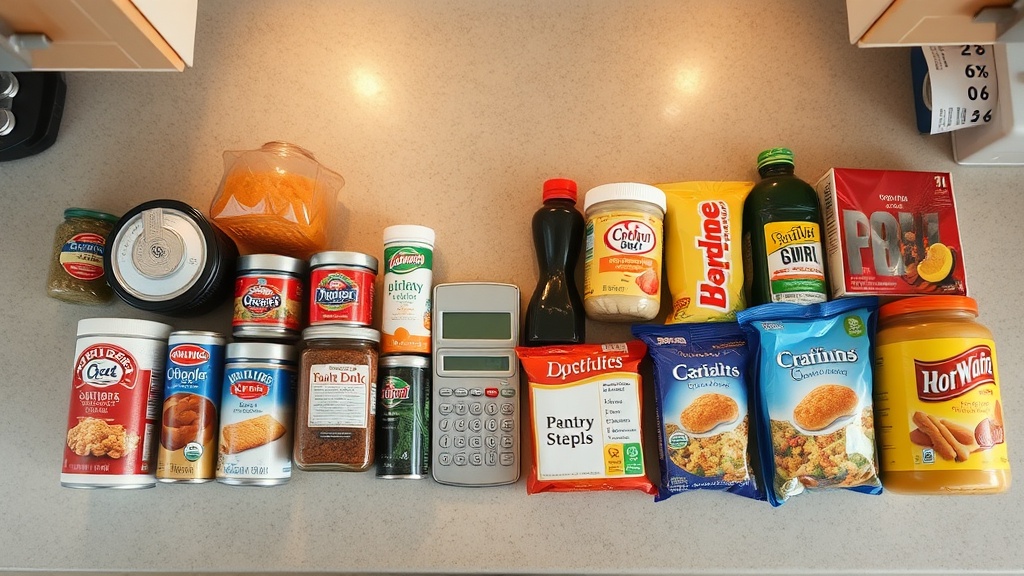
- Bring a calculator to the store. A real one, not your phone. Your phone is a distraction machine. I use a TI-30X that lives in my purse and yes, Derek has commented on this.
- For every item on your list, check the unit price on the shelf tag. If the store doesn't show unit price (some don't, which should be illegal), divide the total price by the size/count yourself.
- Compare the store brand unit price to the name brand unit price. If the savings is 20% or more AND the product is something where quality doesn't vary much (staples, canned goods, frozen veg, baking supplies), switch.
- For anything where taste or performance matters to your household, buy both once. Test it. If nobody complains, you've found a permanent switch.
- Track your switches. I keep a simple list on paper in my kitchen: "SWITCH" column and "KEEP NAME BRAND" column. It took about six weeks to finalize my list, and now I don't even think about it.
The Math on My 34-Item Test
Out of 34 items tested:
- 22 items: switched permanently to store brand (avg savings 33%)
- 5 items: store brand acceptable but name brand frequently goes on sale low enough to match, so I buy whichever is cheaper that week
- 7 items: keeping name brand (quality difference mattered to my household)
Weekly savings on a typical $140 grocery run: $31.74
Monthly: $126.96
Annual: $1,650.48
That's not theoretical. That's real money I tracked over four weeks of identical meal plans — one month name brand, one month with my store brand switches. Same meals, same portions, same household satisfaction level. I asked Derek to rate dinners on a 1-5 scale without telling him why. He's very patient.
One More Thing
Store brands are getting better every year. According to the Private Label Manufacturers Association, store brand dollar share hit a record in 2025, and it's still climbing. Retailers are investing real money in quality because they make better margins on their own brands. The gap between store brand and name brand quality keeps shrinking while the price gap stays wide.
You don't have to go all-in. Start with five items from the slam dunk list. Do the unit price math. See what your family notices (probably nothing). Then expand from there.
Your grocery budget will thank you. Your meals won't change. And you'll have an extra $1,600 a year for literally anything else.