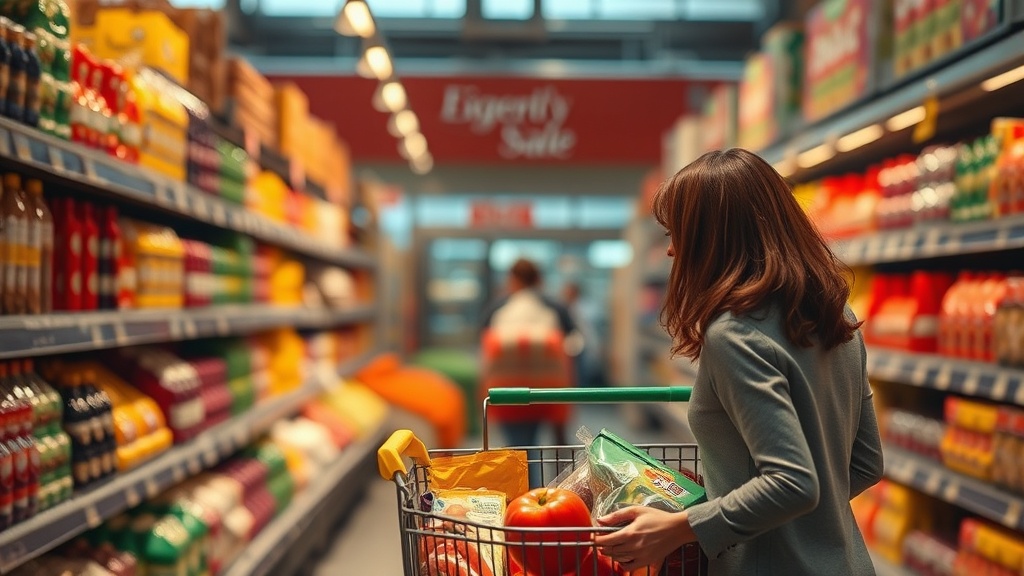
Why Your Grocery Store's 'Sale' Might Be Costing You More

This guide will teach you to read grocery shelf tags like a forensic accountant—spotting phantom discounts, calculating true unit costs, and identifying when that "limited time offer" is actually a price hike in disguise. You'll learn the specific math formulas stores hope you never use, plus the free tools that make price tracking automatic.
How Do Grocery Stores Trick You Into Thinking You're Saving Money?
The red "SALE" tag isn't always your friend. Retailers know that shoppers make 70% of purchasing decisions in-store, and they've built an entire playbook around manipulating your perception of value. The most common trick? Temporary price inflation followed by a "discount" back to the original price—or higher.
Here's how the cycle works. A box of cereal sells for $3.49 regularly. The store raises it to $4.99 for three weeks—just long enough to establish that as the "compare at" price—then slaps on a "SALE! $3.49" tag. You feel smart. You grabbed the deal. Except you paid exactly what it cost last month.
Another favorite tactic is the shrinkflation shuffle. Your ice cream carton shrinks from 1.75 quarts to 1.5 quarts. The price stays $4.99. The unit price (that tiny number on the shelf tag) jumps—but most shoppers never look. They're too busy grabbing the familiar package with the familiar price.
Then there's the BOGO trap. Buy-one-get-one-free sounds like 50% off. Sometimes it is. But when the "regular" price was inflated by 60% before the promotion? You're paying more than the everyday price at a competitor. The math matters—and we'll break it down shortly.
Your defense starts with skepticism. That bright yellow tag isn't a gift. It's a piece of marketing designed to trigger loss aversion—the fear of missing out on savings. Train yourself to pause. Ask: "What was this last month?" If you don't know, you're shopping blind.
What Is Unit Pricing and Why Don't Stores Want You to Use It?
Unit pricing is your X-ray vision into true costs. It's the price per ounce, per pound, per 100 count—whatever standard measure makes products comparable. And yes, stores deliberately make it hard to find.
Look at the bottom left corner of most shelf tags. That tiny print—often grayscale on beige—is the unit price. Compare a 12-ounce "value pack" of shampoo at $8.99 (74.9¢ per ounce) against the 18-ounce regular bottle at $10.99 (61.1¢ per ounce). The "value" pack costs 22% more per ounce. This isn't rare. It's the norm.
Stores obscure unit pricing in three ways. First, inconsistent units—one cereal shows price per ounce, another shows price per 100 grams. You can't compare without a calculator. Second, placement—unit prices sit below eye level, in fonts designed for compliance, not clarity. Third, temporary tags during sales often omit unit pricing entirely. They want you focused on the big bold total, not the math underneath.
Here's your audit formula: Divide total price by total quantity. Always convert to the same unit. Keep a running list on your phone. Within three shopping trips, you'll spot patterns—the genuine price floors that appear every 6-8 weeks, versus the fake "sales" that recycle every other week.
Several apps now scan and track unit prices automatically. Consumer Reports maintains detailed guidance on using unit pricing effectively, including which stores follow proper labeling laws and which exploit loopholes. Knowledge is your leverage—and it's free.
When Is a Buy-One-Get-One Deal Actually a Bad Deal?
BOGO promotions generate dopamine. They feel like winning. But forensic shopping requires removing emotion and running the numbers—especially because not all BOGOs are created equal.
Consider the true discount formula. True BOGO (buy one, get one free) = 50% off per item. BOGO 50% off = 25% off per item. Buy two, get one free = 33% off per item. Most shoppers can't calculate this under fluorescent lights while managing a cart and a shopping list. Retailers count on that cognitive load.
Now layer in the price inflation problem. A 16-ounce jar of peanut butter normally sells for $3.49 at Store A. Store B runs "BOGO Free" at $5.99. You pay $5.99 for two jars—$3.00 each. You "saved" 49¢ per jar versus Store A's regular price. But Store A runs genuine 30% off sales every six weeks, dropping that jar to $2.44. The BOGO "deal" cost you 56¢ more per jar than waiting for the real sale.
There's also the inventory risk. BOGO deals push you to buy double quantities. Will you use both before expiration? A 2018 study from the EPA on household food waste found that bulk promotions contribute significantly to spoilage—meaning you paid full price for the privilege of throwing food away.
The exceptions exist. Non-perishables you definitely use—rice, toilet paper, canned goods—can make BOGOs worthwhile if the math works. But only if you verify the unit price against your price history. Never assume the bright sticker equals savings.
Where Can You Find the Real Price Floor Data?
Stores rotate sales on predictable cycles. Coffee goes deep discount every 4-6 weeks. Frozen pizza hits bottom prices before football weekends. Cereal drops in January (New Year's resolutions) and September (back-to-school). These aren't secrets—they're inventory management patterns you can exploit.
Your personal price book is the tool that reveals these cycles. Not a shopping list—a historical record. Track the item, the store, the date, the total price, and the unit price. After 8-12 weeks, clear patterns emerge. You'll see that "sale" on pasta sauce hits $1.49 every third week—so you know $2.49 isn't a deal, it's the markup cycle.
Digital tools make this easier than the spiral notebooks I started with in 2019. Apps like Flipp aggregate weekly circulars and let you search historical pricing across multiple retailers. Some grocery store apps (Kroger, Safeway, Wegmans) show "typical price" alongside sale prices—though verify these independently, as they're self-reported.
The real price floor—the absolute lowest a product sells for—usually appears during seasonal transitions and manufacturer coupon cycles. When a coupon overlaps with a genuine sale (not an inflated BOGO), you hit what's called "stacking velocity"—the point where margins compress and savings maximize. These windows last 3-7 days. Your price book tells you when to strike.
One final note on loyalty programs. Those "member only" prices aren't rewards—they're data collection tools. The store tracks every purchase to optimize their pricing psychology against you. Use the discounts. Pay in cash when possible. And never let the loyalty app replace your own price history. Their "personalized deals" are algorithms designed to move inventory, not save you money.